
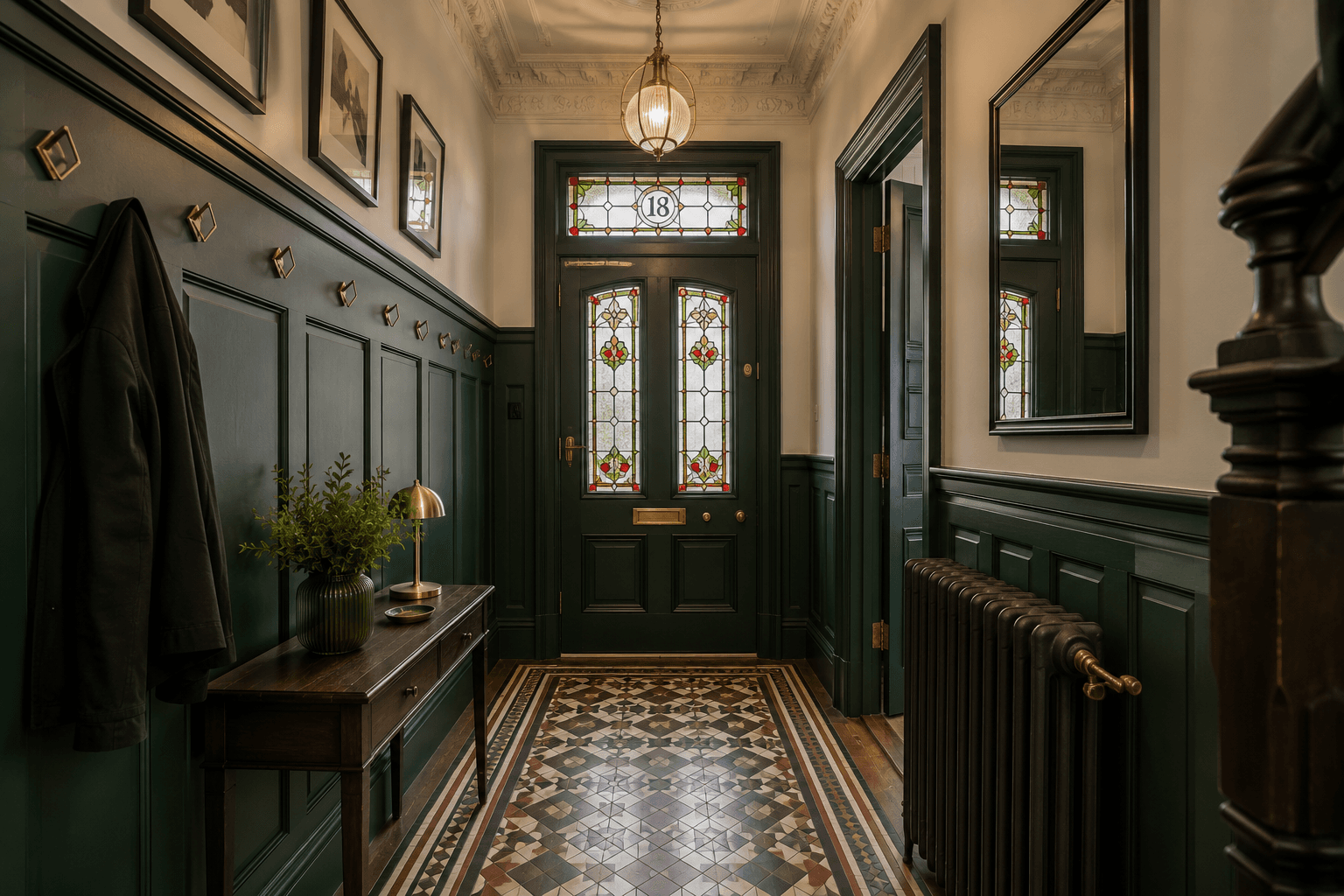
Forest wainscoting under white plaster, twelve aging brass hooks, encaustic geometry underfoot and the stained-glass door as daily theatre: the Victorian hallway, faithfully alive.
The idea behind it
The hall works because every element is both ornament and tool: hooks are the sculpture, tiles are the doormat, the radiator is the drying rail, the stained glass is the mood lighting. Victorian design never separated beauty from duty — the restoration keeps the marriage.
Colour splits the labour: green absorbs the family's daily brush-past below, white bounces the door's coloured light above. A narrow corridor becomes generous by assigning each half of the wall a different job.
What you will need
Forest-green wainscoting, Panelled dado in deep matte heritage green
Brass hook parade, A dozen diamond-backed hooks left to patina
Stained-glass entry door, Numbered transom and floral panels, restored or reproduced
Encaustic-style floor, Cream, rust and charcoal geometry to the stair
Dark console table, A slim two-drawer piece for lamp and letters
Cast-iron radiator, Column style with brass valves, painted deep
Ribbed glass globe light, Warm brass-stemmed pendant overhead
Steal the look
Step 1
Fit or restore panelling to dado height and paint it forest green, matte.
Step 2
Keep upper walls warm white and hang a slim black-framed picture row.
Step 3
Mount the brass hooks in an even march at 165cm — patina encouraged.
Step 4
Lay encaustic-style porcelain from door to stair, geometry centred on the hall.
Step 5
Place the dark console with lamp, dish and ferns; hang a mirror above if light is scarce.
Step 6
Keep the cast-iron radiator, repainted deep, with brass fittings polished once and never again.
Step 7
Hang the ribbed globe centrally and let the stained glass throw its colours down the tiles.
Perfect for
- Victorian and Edwardian terraces with surviving bones
- Restorers who want function to stay period-honest
- Narrow halls needing both storage and dignity
- Lovers of patina, geometry and coloured light
Avoid if
- The building is modern with no mouldings to anchor the look
- You want hidden storage — this style hangs life on the wall
- Deep greens feel heavy without generous door glazing
Estimated budget
Budget
Wainscot kit, forest paint, reproduction hooks, patterned porcelain runner-zone and a globe pendant.
$700-$2,000
Mid-range
Joiner-fit panelling, full encaustic-style floor, restored radiator and antique console and hooks.
$2,000-$6,000
Luxury
Stained-glass door restoration or commission, original tile repair, bespoke panelling and period lighting.
$6,000+
Colour palette6 tones
Forest Panel
wainscoting and door
#31413A
Plaster White
upper walls and cornice
#EFE9DD
Hook Brass
hooks and hardware
#AC8B52
Tile Rust
floor geometry
#9E5F43
Stained Ruby
door glass accents
#A33B33
Console Walnut
furniture and stair
#4C3626
Frequently AskedQuestions
Deep heritage tones — forest, bottle green, ink, aubergine — to dado height with warm white above. The dark base hides scuffs and grounds the ornate mouldings the era loved.
Porcelain reproductions carry the geometry with none of the sealing upkeep, shrugging off boots and buggies. Originals restore beautifully but want specialist cleaning and patience.
Keep everything above the dado pale, mirror the console wall, choose glass-globe lighting over shades, and let the front door's glazing work unobstructed. Dark stays below; light owns the top half.
Join the conversation
Share your thoughts on this room.