
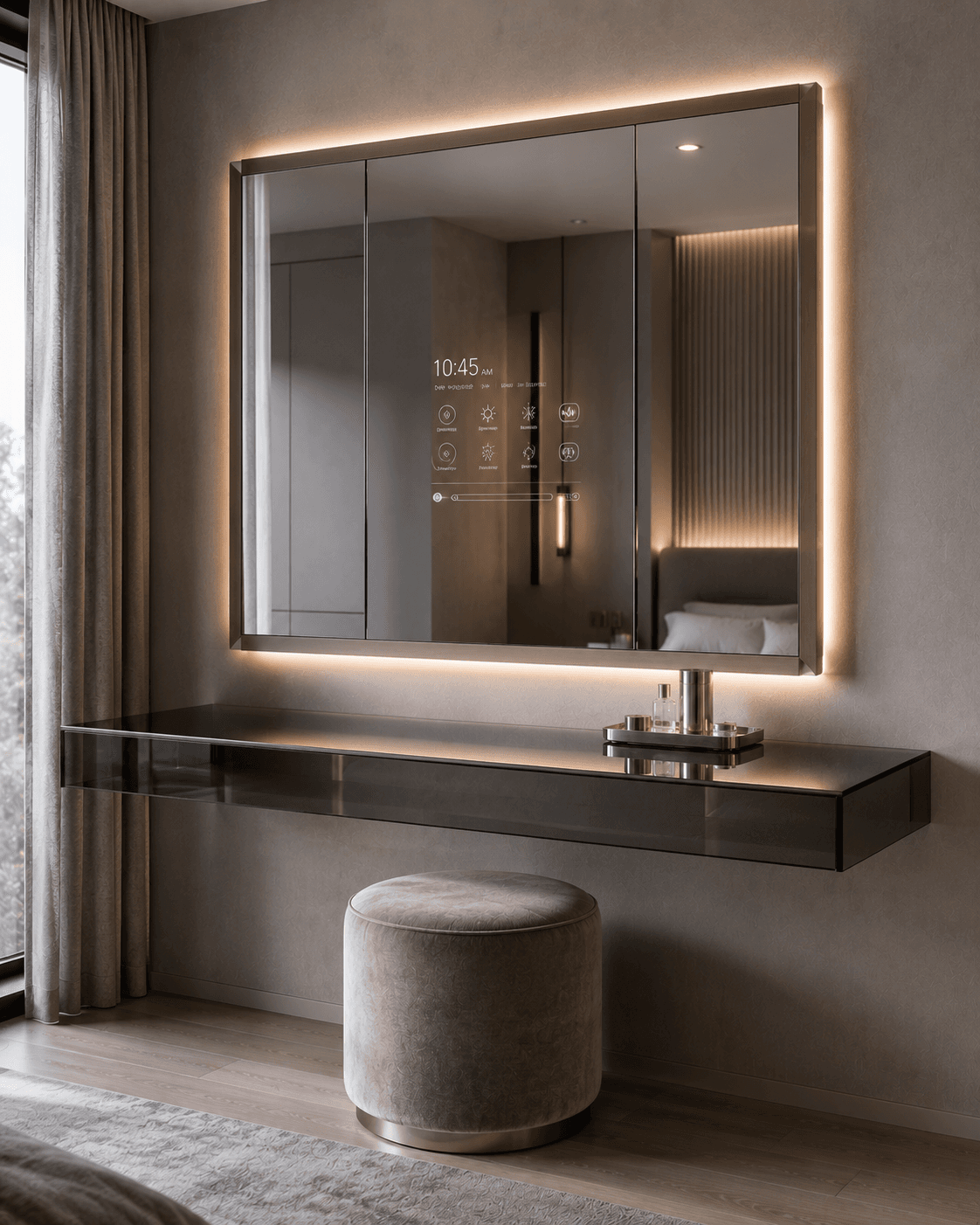
A quiet-tech corner: a wide halo smart mirror floats time and weather behind two-way glass, a smoked-glass console cantilevers below like a shadow with drawers, and warm light keeps the grey-taupe palette humane.
The idea behind it
The design's restraint is the point — glanceable data instead of a screen, halo light instead of fixtures, transparent storage instead of mass. Every element does its job while pretending not to be there.
The smoked console is the boldest move: engineering (toughened glass, steel cantilevers) disguised as absence. It keeps the floor visually continuous, which is why the corner feels larger than its footprint.
Warmth is engineered against the tech: 2700K halo, taupe plaster, velvet pouf. The greys stay soft because nothing in the room emits cool light — including, deliberately, the display.
What you will need
Smart halo mirror, A wide mirror with warm backlight and a two-way-glass display module.
Smoked glass console, Toughened tinted panels on steel cantilever brackets.
Concealed socket + Wi-Fi, Power behind the mirror; network coverage for the display.
Mushroom velvet pouf, A soft round pouf on a chrome ring.
Chrome tray, The single metallic accent, holding daily bottles.
Taupe plaster walls, Warm grey backdrop keeping the tech soft.
Greige curtains, Full-height panels softening the window wall.
Warm dimmer scene, Halo and display brightness dropping together at night.
Steal the look
Step 1
Rough-in a socket at mirror height and confirm Wi-Fi reach before anything else.
Step 2
Mount the smart mirror with the display centred at standing eye height; halo on a dimmer.
Step 3
Fix steel cantilever brackets into studs and hang the smoked glass console at 73–75 cm.
Step 4
Configure the display minimal: time, weather, one calendar — nothing scrolling.
Step 5
Warm-tint the UI and cap its brightness to match the halo.
Step 6
Organise the glass drawers with fitted trays — silhouettes stay tidy.
Step 7
Style with the chrome tray only; add the pouf.
Step 8
Set a night scene: halo low, display near-off.
Perfect for
- Tech-minded minimalists
- Phone-free-morning aspirants — the mirror replaces the scroll
- New builds and rewires where sockets are cheap
- Grey-palette bedrooms needing a function anchor
Avoid if
- No power at mirror height and no appetite for trunking
- You dislike visible (even silhouetted) storage
- Warm rustic schemes — this corner is deliberately sleek
- Screens in the bedroom are exactly what you're escaping
Estimated budget
Budget
Standard halo mirror plus a small smart display beside it, glass-look acrylic console and high-street pouf.
$400-$1,000
Mid-range
Integrated smart mirror module, toughened smoked-glass console on steel brackets and concealed wiring.
$1,000-$3,200
Luxury
Custom three-panel smart mirror wall, bespoke cantilevered glass joinery and scene-programmed automation.
$3,200+
Colour palette5 tones
Taupe Plaster
walls
#CDC3B6
Smoked Glass
console
#5A554F
Halo Warmth
mirror glow
#FFE9C6
Mushroom Velvet
pouf
#A5988A
Chrome Line
tray and ring
#C7C9CC
Frequently AskedQuestions
A slim display sits behind two-way mirror glass; bright interface elements shine through while the rest stays reflective. Off-the-shelf modules (or a tablet in a mirror-glass frame) show time, weather and calendars — choose one with a dimmable, warm-tinted UI so it never reads as a screen.
Toughened smoked glass is stronger than it looks and hides fingerprints better than clear glass. The real demand is tidiness — contents stay silhouetted — so pair it with a drawer organiser system and keep backups elsewhere. Mount on rated steel cantilever brackets.
Yes — plan a concealed socket behind the mirror position and Wi-Fi coverage. Wiring at mirror height during any renovation costs little; retrofitting later means surface trunking or a visible cable.
Join the conversation
Share your thoughts on this room.