
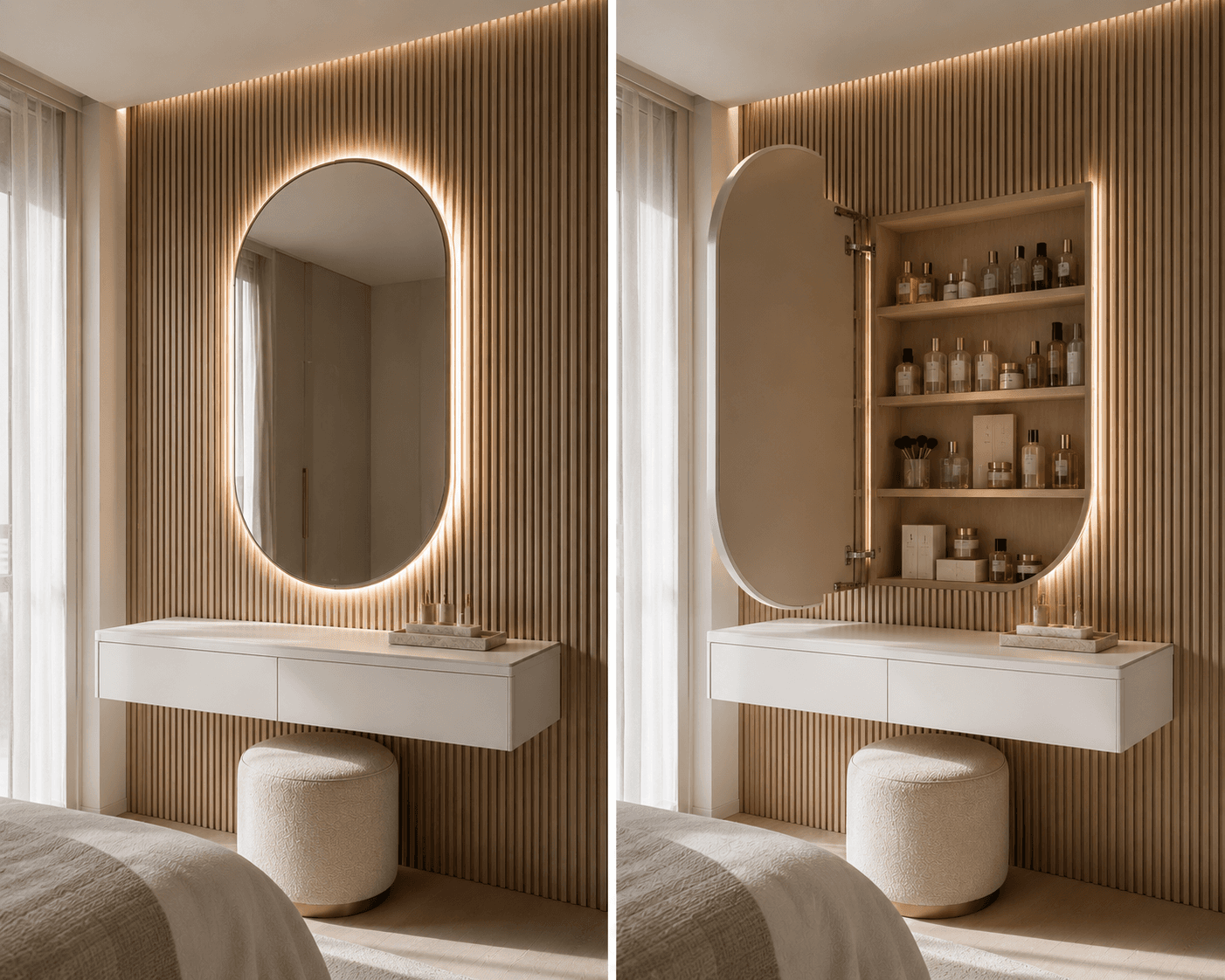
A Japandi corner with a secret: the oval halo mirror on the fluted oak wall is a hinged door, opening to an oak-lined, edge-lit cabinet that swallows the entire skincare routine — while the white floating console below keeps only the calm on show.
The idea behind it
The design solves the vanity's oldest conflict — serene surfaces versus real product volume — by giving the mess a beautiful, invisible home at eye level. The reveal is the delight; the discipline is automatic because closing the mirror is the tidy-up.
Camouflage is engineered: the cabinet recesses into the wall, and the fine fluting hides its cut line between ribs. Even the halo's glow doubles as a distraction from the door edge.
Storage splits by posture — seated essentials in the console drawers, standing-height rows behind the mirror — so nothing lives more than one gesture from where it's used.
What you will need
Oval mirror-door cabinet, A backlit oval mirror hinged as the door of a recessed storage box.
Fluted oak wall, Fine vertical ribbing cladding the vanity wall and hiding the cut line.
Oak-lined interior shelves, Three or four shelves with warm edge lighting inside the cabinet.
White floating console, A two-drawer unit with push-latches at 72–75 cm.
Piano hinge + soft-close stays, Hardware rated for a heavy glass door.
Boucle pouf on brass ring, Tucks fully beneath the console.
Travertine tray, The counter's single styled object.
Warm LED throughout, Halo and shelf strips matched at 2700K.
Steal the look
Step 1
Open the stud wall and frame a recess 10–15 cm deep sized to the oval.
Step 2
Fit the cabinet box, line it with oak and wire edge-lit shelves to a door switch.
Step 3
Clad the wall in fluted oak, running ribs over the cabinet's perimeter cut.
Step 4
Hang the oval mirror-door on a piano hinge with soft-close stays; halo on a dimmer.
Step 5
Mount the white console beneath; drawers take seated-use tools.
Step 6
Load the cabinet by routine rows; tall bottles on the bottom shelf.
Step 7
Style the counter with one tray only — the emptiness sells the trick.
Step 8
Check the door swing clears the counter styling and the pouf.
Perfect for
- Small bedrooms where storage must vanish
- Skincare-heavy routines with serene-room ambitions
- Japandi, minimal and warm-modern schemes
- Anyone who loves furniture with a reveal
Avoid if
- Solid masonry walls and no appetite for surface-mounting
- You prefer display storage — this hides everything
- Heavy daily door use worries you (hinges need quality)
- Fluted cladding exceeds the budget — the camouflage is the design
Estimated budget
Budget
Surface-mounted oval mirror cabinet, stick-on fluted panels, flat-pack white console and battery shelf lights.
$350-$900
Mid-range
Recessed custom box with oak lining, quality hinged halo mirror, timber fluting and wired door-switch lighting.
$900-$2,800
Luxury
Bespoke joinery wall with invisible-seam cabinet, made-to-measure mirror door and integrated scene lighting.
$2,800+
Colour palette5 tones
Ribbed Oak
fluted wall and shelves
#C49C6C
Soft White
console and ceiling
#F3EFE7
Halo Amber
mirror and interior glow
#FFE8C4
Travertine
tray and accents
#D9C9AF
Boucle Cream
pouf
#EAE4D8
Frequently AskedQuestions
Exactly like a bathroom mirror cabinet, but designed to disappear: the backlit mirror is the door on a piano hinge, the box recesses into the stud wall, and a fluted or slatted wall finish hides the cut line. Interior shelves get edge lighting so the storage is genuinely usable.
10–15 cm interior depth holds skincare bottles, brush pots and most backups — conveniently within a standard stud wall's cavity. Anything deeper must build proud of the wall; trim it in the wall material so it reads as a pilaster rather than a box.
The renter's version is a surface-mounted mirror cabinet framed with stick-on fluted panels around and over the box. It projects about 12 cm but reads as a panelled feature; everything removes with the panels when you leave.
Join the conversation
Share your thoughts on this room.